Google+ bakers and astronauts: play
Showing posts with label play. Show all posts

14 April 2015

Expanding Playwork + Adventure Playgrounds


"Play is a very personal experience.  For some it is dolls and fights, for others it is climbing and skipping.  It is what children do when adults are not there or what the children do when the adults that are there are perceived as honorary children."

Bob Hughes, Evolutionary playwork and reflective analytic practice, 2001, p. 11


Many of you know that I spent time in 2013 and 2014 creating a project called Play Lab.  The goal of the project was so show my community what high-quality, play-based education can look like.  I brought open-ended materials to spaces like the Farmer's Market, the library, a local art gallery, and neighborhood art walks.


A few weeks ago, my wonderful colleague Alison Coombs and I presented at the National Art Educator Association's Annual conference on The Materiality of Playwork.  Before standing and presenting with Alison, I do not think I realized that Play Lab was playwork.  But reflecting on the time that I have spent facilitating children's play, I see that my role was not a curator or director or teacher, but rather, a playworker.

I have always wanted to be an "honorary child", as Bob Hughes puts it, in the eyes of the children I work with.  Not a fly on the wall, not a playmate, but someone children can trust.  Friends of mine who have children never fail to marvel at their 18-month-old's chattiness in their room when they wake up in the morning or from a nap.  Young children truly play for themselves, as a way to understand the world.  As they grow older and play with others, their real, true play is unfiltered.  When adults are not present, children can try on different behaviors, maybe even dangerous ones.  The wonderful thing about playwork, and playworkers, is the power that they give to children to explore, to somehow get to that place where they are not the powerful, all-knowing adult, but rather a supportive, interesting person in the environment:  an honorary child.


Playwork is probably most often connected with adventure playgrounds, something that is far from common in the United States.  In the UK, adventure playgrounds have been around for decades.  In the short documentary film The Land, filmmaker Erin Davis explores both playwork and adventure playgrounds, focusing on Plas Madoc, an adventure playground in Wales.


In an interview with NPR, Davis made a powerful statement about the difference between play in the past and play in the present:

"[Kids] climb things, they hide in things, they create dens and places to hide in, create hierarchies and worlds of their own. They're drawn to fire, they're super-imaginative. What's different [today] is the degree to which they have an opportunity to express and pursue these interests. So it's surprising to us — but really it shouldn't be — that kids thrive in these environments when they can do really whatever they want. They have the play drive. It's up to us to kind of provide the kinds of opportunities for them to really follow through on it."
 The issue that arises over and over again, it seems, is not about children's desire to play, but rather the adult reaction to idea of risk.  As adults, we are averse to idea of children being in harm's way.  One does not need to be a parent or a teacher to have a desire for children to be safe.  But if we prevent failure by cushioning everything we can, how do children learn?  How can adults shift their perception of risk and danger to make space for it in our culture?  Adventure playgrounds were created, and stick around, because they are places for children to experience danger.  Playworkers make that possible.


The question must be asked:  how can we, as educators, advocate for play?  How can we become honorary children?  We can start by celebrating the move towards adventure play and open-ended exploration over pre-scripted lessons and blanket ideas that are meant to apply to everyone.


I hope you'll help me create a map of Adventure Playgrounds around the world.  I have started with a few in the United States, and I hope we will be able to create a rich resource for anyone interested in advocating for open ended play in supportive spaces.


Please share your thoughts, comments, and questions on playwork and adventure play in the comments.

06 June 2013

Evidence of Play

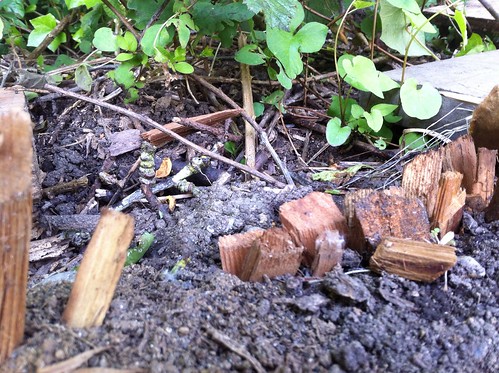
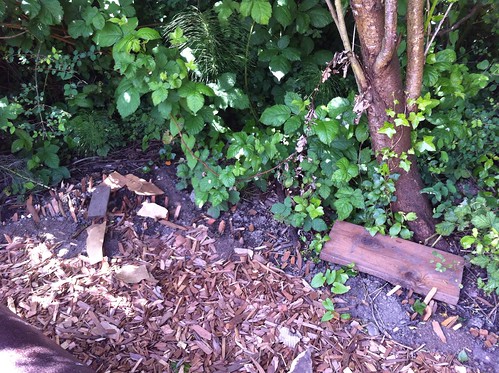
In this little corner of the farm, there are wood chips on the edge of some blackberry bushes.  Nothing too special to the naked eye, really.  But go ahead - look closer.


Untitled


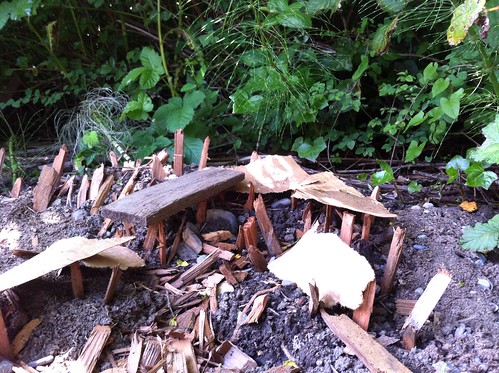
Some wood chips in less-than-natural positions drew my eye in. A few standing in a row made me think that maybe someone sat for a few minutes, fiddling with some found things.


Untitled


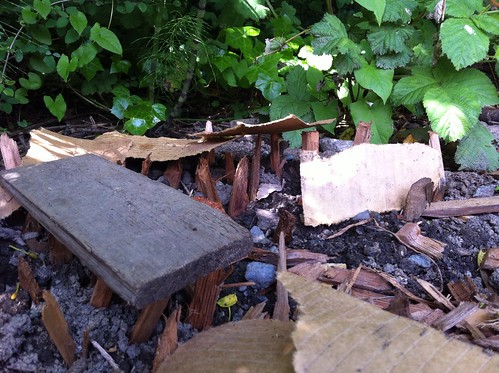
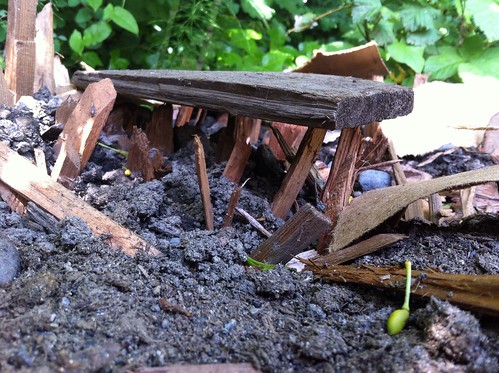
I walked closer to get a better look and saw some serious evidence of open-ended, self-directed play.


Untitled


Untitled


Untitled


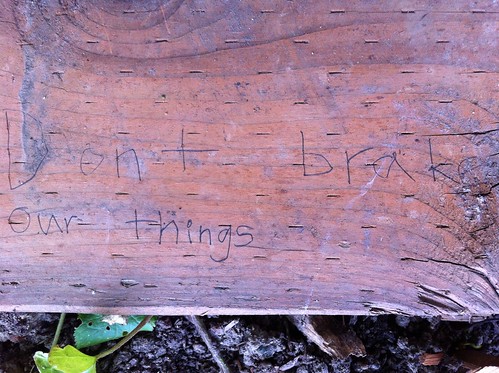
And to top off these little structures, there was some writing, asking unassuming guests not to disturb these creations, because the play isn't done.  So much more can happen!


Untitled


I promise, I won't.  But I'm looking forward to heading to the farm next Thursday and seeing what has happened to this little world under the blackberry bushes.


06 March 2013

Free Play and Education


The UK has a rich history of supporting free play in outdoor spaces, usually known as adventure playgrounds.  Engage for Education is a Scottish group that is looking for opinions from the public about different facets of education, and they use the feedback they gather to try and initiate change within the government.  They recently ​posted a piece that Juliet wrote on free play.

She talks about so many things that are missing from education:  open-ended play, reflection time, inquiry, and nature.  She also addresses the link between natural, open-ended play and behavioral issues.   She shares the perfect quote from Play England:


“Playing is central to children’s physical, psychological and social well-being. Whilst playing, children can experience real emotions, create their own uncertainty, experience the unexpected, respond to new situations and adapt to a wide variety of situations. Play enables children to form friendships and attachments to adults and to places, allowing for the development of familiarity and intimacy with both. It can provide opportunities for independent learning and building confidence, resilience, self-esteem and self-efficacy.” 


Head over to Engage For Education to read Juliet's piece, and perhaps to join the conversation!

25 February 2013

Treasure!

This is a beautiful thing to find in the storage space of your new apartment:  a handmade trunk, covered in an interestingly patterned fabric.


I was happy enough to find it because we need a new ottoman, and buying a new one just isn't very interesting to me.  But the fun did not end at interesting fabric and a place to rest my feet...


It is filled with handmade blocks.  There are a few lincoln logs (the old wooden ones!) and some dowels, but this is basically a mix of squared off pieces of wood.  


I've long thought that I want a big bowl of legos on my coffee table - If I can ever snag some used ones, it will still happen.  But now, when I, or anyone in the house for that matter, is looking to play, we'll just open up the magic trunk!


I have a feeling you'll be seeing these far too much in this space!  Its playtime!

27 July 2012

Weekend Links


This exhibit at MOMA looks fantastic, so if you are a New Yorker, I think its a must-see.  There is a collaboration happening with Pop Up Adventure Play on August 10th, bringing open-ended exploratory play into one of the most famous spaces in the world.  I would love to see that!

Also at MOMA is Ecstatic Alphabets / Heaps of Language.  I've been on a bit of a kick thinking about exploring literacy in less traditional ways, and I love some of the images I'm seeing here.


I'm inspired by the Dial-A-Poem portion of the exhibit, too - dont you think that is something that could be incorporated into a school setting, with children recording their stories and somehow making them accessible to families, or as a choice in the classroom?


I came across Learning Materials Workshop this week, which has a blog, but the big star for me is all the gorgeous materials that Karen, the artist and owner, has in her shop.  Her materials are Reggio inspired, and she also distributes books published by Reggio Children.  Karen has also done some writing, including this piece on the history of educational toys.

A little reminder that next week will be the start of a read-along of Imagine: How Creativity Works by Jonah Lehrer.  An introductory post will be up on Wednesday, and we're planning to read a chapter every few days.  If you've read it before or not, I hope you'll join us!  You're also welcome to join in the conversation in the comments - that's where all the action will be!


Happy Weekend!

18 November 2011

06 October 2011

water + laughing


I have had moments when I have told children to stop something like this - pouring water on someone else.  These girls are clearly enjoying the pouring, the repetition, the sensory aspect of cool water on their arms - this is work.  An adult might stop them because they assume a child wouldn't want another to pour water on her arm; because it is to loud for the teacher's taste; because there is a "keep to yourself" type rule at the sensory table.

I love seeing things in the classroom that I have never seen before.  I'll share another moment that made me stop and think later today.

22 September 2011

a space for writing and play


Its almost silly how beautiful this room is.  Look out the window, and you see Young's Bay, Saddle Mountain and the rest of the Oregon Coast Range, bridges, fishing boats, Coast Guard Helicopters - those are some exciting windows.  I'd like to figure out how we can get the kids up to window level so that they can see a bit more.  Stepstools?  Crates?  Giant blocks?

I don't think I've gone without a place for writing and drawing in the classroom in six years.  Once I made it part of the environment, I never dismissed it.  It can be an amazing gathering place - especially in a mixed age grouping like this one.

There is more to do to make this as inviting as it can be, but including a place for the to share the children's work is important.  Hopefully this radiator cover will become that place for sharing.  It is at the children's level, so they will be able to put things up and take them down.  But for now, we're getting into the routine of using this as a writing and drawing space :  the children go and get the materials they need (a variety of papers, writing tools, tape, glue, and the hot item of the moment, scissors) and they bring them to the table to write and draw and create - whatever they please.  I sometimes forget that getting children into the routine of choosing for themselves and getting the items that they need takes a bit of time at the start.  But we're definitely getting used to it.  I'm really missing those black felt tip pens that we were up to our ears in at my last school!  But the space comes together, little by little, and the more I watch and listen, the more I notice what we could add to promote writing. The right materials for will encourage writing through exploration.


For now, we're cutting up a storm!


21 September 2011

those little animal figurines

My favorite moment:

I'm hungry for some fish!  Can you get me fish?  From the sea?


This was one of my favorite moments of the day, and I was happy to capture it on video.  Just one of the many ways that imagination manifests itself among threes and fours.

28 September 2009

A Romantic Idea?

"[Bodrova and Leong] say, after all, that play should have a central place in early-childhood classrooms. And they do find fault with the academic approach, arguing that in practice, many of the early-childhood academic initiatives that have been introduced in the No Child Left Behind era have failed to produce any significant improvement in academic skills. At the same time, they don’t agree that the solution is unstructured free play. The romantic idea that children are born with flowering imaginations and a natural instinct for make-believe is simply wrong, they say. Especially these days, they contend, when children spend more time in front of screens and less time in unsupervised play, kids need careful adult guidance and instruction before they are able to play in a productive way."

I'm having some trouble with this one. It is an interesting article, but I had a few moments where I thought, Excuse me? Come again? Like here. If children are not "born with flowering imaginations and a natural instinct for make-believe", I'm not sure where it comes from. In my opinion, our job is to support and enhance those flowering imaginations. And when interest-based, emergent, child-centered curriculum is done wrong, then it can be chaos - teachers should not assume that because they are letting the children lead, they have nothing else to do. It should give you more to do to prepare for the next steps.

Children know how to play. It's what happens when we step back and watch and we don't interfere.

Read it for yourself. What do you think?

22 February 2009

Playtime!


It is officially the winter break, and, just two days into it, I am already satisfied. Making bread, watching Woody Allen movies, taking naps, and knowing that I do not have to wake up at 6 am on Monday morning -- all good things so far.

But thinking about education, and learning more about it, is inevitable. As soon as I switch on my computer, I'm looking for more. And, in the spirit of vacation, we should play games!

The Invention Playhouse at the Lemelson Center for the Study of Invention and Innovation is a neat spot from the Smithsonian Institute with a few interactive games.

After playing Cloud Dreamer for a little longer than I should have, I watched Does Play Matter?, a great piece on children's play and how important it is to development. This is always coming up in early childhood education, of course, but I feel like it has been really present for me lately. It may be the visit to the forest preschool that really set me off -- I'm not sure. But it really does matter, and I always love reading and seeing what other people have to say about it.

What do you have to say about play?
Related Posts Plugin for WordPress, Blogger...