Google+ bakers and astronauts: preschool
Showing posts with label preschool. Show all posts

07 February 2012

treasures and pirates

Today at the maker's table, the children worked on a treasure map.  We had the paper strips, tape, crayons, and markers to work with.  When we gathered together in the morning, I told the children that we should try to make a map using those things, and I asked what they knew about maps. Conversation immediately turned to pirates and treasure.  Three children started out helping with the map and they stayed for about 10 minutes, adding the features in the pictures below.  There were also chipmunks, babies, and cords added.  


taping down roads


adding new kinds of roads


more roads, an ocean, and an airport


making pirates


and adding them to the treasure map.

I chose this prompt because of some map-making I've seen here and there online lately, and also because of the interest the children have in using a map during dramatic play.  It has been a challenge for me to document and make connections across days and weeks in this setting, but explorations like this seem really positive because the children engage in something very open-ended, and I learn a lot about them as they talk and work.  Our plan is to add to it tomorrow - the tape was a hit, but we'll also offer more materials, and do more to get conversation started about what this map can be for.


31 January 2012

Drawing on Mirrors Again

This post needs few words: Mirrors, dry-erase markers, and some towels for erasing make for a very engaging morning.


26 January 2012

Making a Decision

I have never really been one for themes in the classroom.  When I started my career as a teacher, I went though a time when dramatic play would be transformed by a teacher into a post office or a doctor's office or a store, with props to match.

I have not shared much about my Action Research project that I am working on this semester.  It is taking a lot of my energy, but it is definitely a positive thing.  I am focusing on Children's imaginative play for my project, so I have been spending a lot of time watching children engaged in imaginative play, and the easiest place to see and capture that is in the dramatic play area.  I gather videos and notes each Tuesday and Thursday as I watch children play, and for the first two weeks of this data collection, dramatic play had costumes; plates, cups, and spoons; fabric, and two giant boxes.  The boxes were open ended, and they were everything from jails to houses and caves and stores.  One thing I noticed was that watching that play was like watching a pinball: themes and ideas and roles changed constantly.  Children often revisited the same ideas and concepts, but each idea would have about 3 minutes before switching.

This is not necessarily negative.  This is how they want to play, in a way: they want to try out different things, places, roles, ideas, and more.  That is why I love imaginative play, and I want to promote it constantly in the classroom.

That said, I have been getting more and more curious as I have been watching more imaginative play than average.  Could I help them stick with an idea and get deeper into it?  So many teachers chose a dramatic play theme, and I was curious to try and create a focus in dramatic play without giving something too definite.  I think that if there seems to be just one thing to pretend in dramatic play, some children are bound to never try it out.

The children often play out home themes, with Mommies and babies and bad guys and eating dinner and changing diapers - a big mish-mash of all the ideas and themes that are salient to them.  So, without making a permanent decision like purchasing something, I made a play kitchen out of one of the many IKEA Expedit Shelving units we have in the classroom.


It was all the rage when on Wednesday, the day it was first in the classroom.  Children immediately started pretending to cook, and after a while they were serving it at the table in the dramatic play area. Halfway though the morning, two boys announced that it was their store, and it was open - and it turned into a restaurant, with orders being taken, prepared, and brought to the table.  One of the boys who opened this restaurant has only engaged in dramatic play pretending to be either a tiger or an elk, so we're starting to expand our horizons.

I have to remember not to be afraid to suggest things to children.  I cannot assume that they will just spend all their time pretending to cook and eat: I have seen them be creative and unexpected, and they will likely surprise me, even with a pretend kitchen.

On another note, I now see the potential of these shelves: I'll let you know what we turn it into next!

25 January 2012

magnets


I went on a little Goodwill shopping binge last night and spent $20.  That is a lot of stuff for the classroom!  Most of the $20 was spent on pots and pans for dramatic play (which I'll share more about soon), but I also spent 99 cents on something that proved to be engaging in a different way.


We have a large white board in our classroom - it used to be an elementary school classroom.  We have scribbled with marker and played with some random magnets on it, but this 99 cent "Monkey Puzzle" that I purchased drew children to the whiteboard.  Magnets were shifted constantly; no one was possessive about their creation after they left it, making this natural flow of work throughout the morning.  I would have loved to see a time lapse of the changes on the board - perhaps that will be for another day.  

How do we know what is going to be engaging for children?  What can I learn from this experience today?  How will the children feel about the magnets tomorrow, next week, in a month?

12 January 2012

Homemade Watercolors

I have seen a few things here and there about homemade watercolors, and the time came this week to make some - we were desperate for them in the classroom!  I made them at home from a "recipe" that I found on Whole Living.


I had bookmarked the watercolors from One Golden Apple about a year ago, and I still plan to make those ones.  Those are a bit different, using Fantastix (which are sitting in my amazon cart right now), and we'll be trying those soon.  We'll probably use the ice cube tray again, putting a bit of color from a tube into each part of the tray.

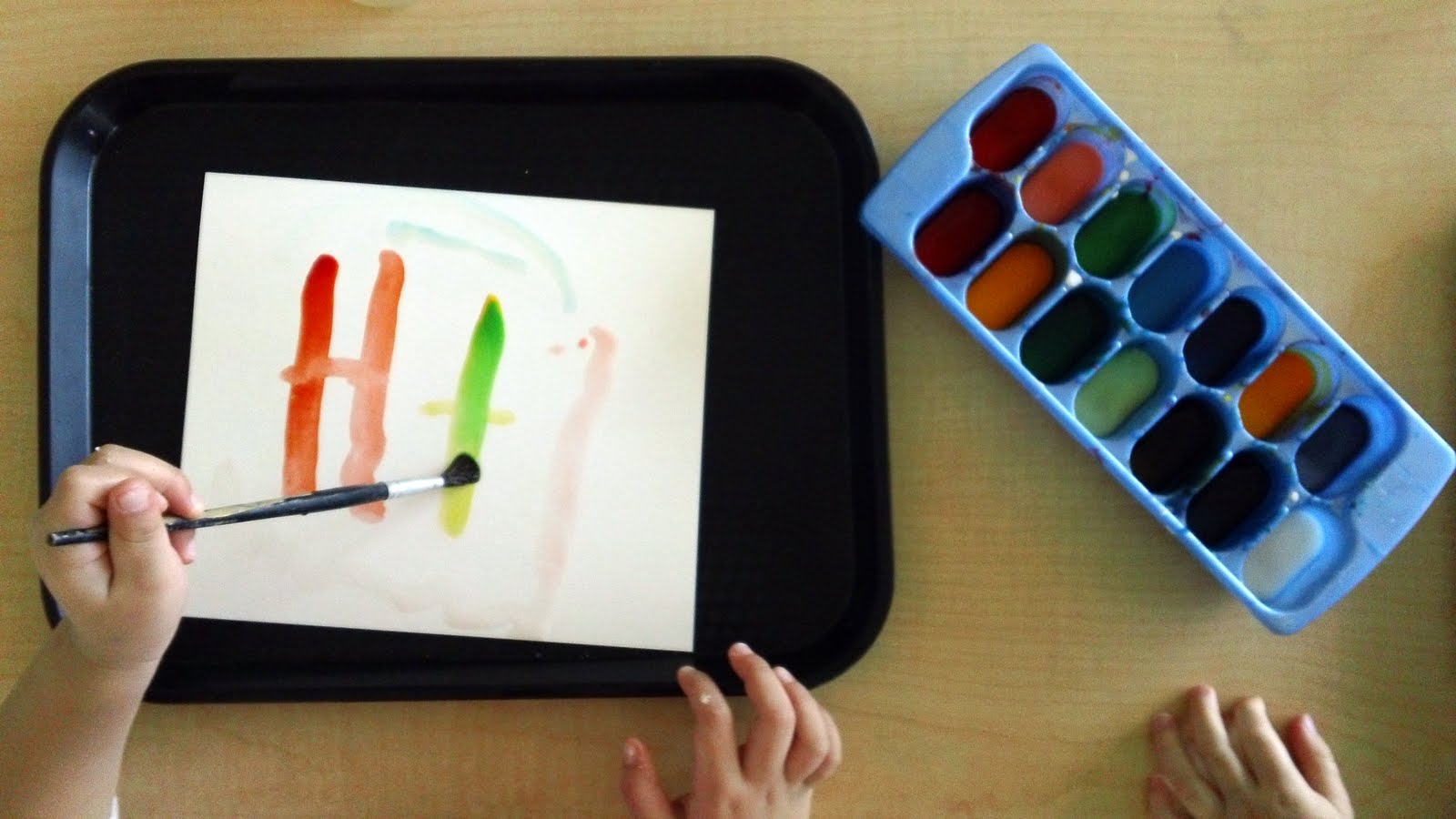
Anyway, I made the paints at home and let them set overnight, and then the children used them the next day.  I was almost giddy when I saw the results!


The paints create vivid colors that drew the children in, some of them remaining to paint page after page .  One thing I have noticed with children and watercolors, especially twos and threes, is that they sometimes get caught up in the water aspect, ignoring or using a minimal amount of paint, and they disengage from their painting because they don't see anything on the paper.  With these paints, I showed them to the children at our morning meeting, making a few marks on the paper myself and modeling how I put paint on the bristles by swiping the brush back and forth a few times.  the texture of the paint deep in the pods is almost magic muck-like, acting like a solid until it is penetrated, and then allowing a paintbrush to dig in deep.  As the morning went on, more and more paintings had a bit of a grit to them, adding a bit of texture.


Overall, I love these paints, and I hope that you'll try them out, too, and let me know how it goes for you!  you can get the recipe over at Whole Living.  With small groups of children or classrooms with extra adult hands to work with a small group, I would definitely recommend making these paints with children, perhaps making them in egg cartons so that children can have their own set to take home.  


11 January 2012

Playing Golf


For ten minutes yesterday, the classroom was a small golf course, complete with instructors. Perhaps the box will become a golf cart.

09 January 2012

Not-A-Box


These are some images from the end of last week - I put two large cardboard boxes in the classroom, and there was action around them for 90 minutes.  Some children came and went, but others stayed with the boxes for extended periods.  The play was about jail, mommies, babies, tigers, cats, amusement parks, and much more that I probably did not catch.

Today, at the start of the week, small groups were using the box as a location for playing with materials from the classroom - for example, two children spent about 35 minutes building with Magna-Tiles in the box.

Tomorrow, I am moving the box to where more of the dramatic play items are, and I'm interested to see if there is a shift in how children use it, and what for.  I have been watching carefully and I have loved to hear the children talk about their plans and see how the box transforms throughout the day, depending on moods and keywords overheard and growling prompts.  Totally fascinating!

05 January 2012

Box Ghost

I could not help but laugh as I watched this, but reflecting on it, I'm trying to imagine what the experience must have been like for F inside of this ghostly box, sailing around the gym, as he peered out the small flap on the side.


Now I'm thinking:  what is the overarching interest with these boxes?  I'll be sharing more documentation on the boxes next week.

Boxes and Ladders


We have a large gym space at the center where I work, and the children play there for about an hour each morning.  There are mats, bikes, slides, a balance beam, basketballs, cones, trampolines, and more - but yesterday, the main attraction was enormous cardboard boxes that were in the corner.

The images above are just a few from a 30 minute period during which two children, Ja and Jo, continually challenged themselves to get in and out of the boxes using the ladder on the wall.  The climbed up alongside the box, moved over to be above the box opening, an then dropped themselves in.  Ja was exploring this independently at first, and it took him almost 5 minutes to get out of the box the first time.  I talked to him as he tried, giving him ideas about where to put his hands, but never physically assisting.  Jo saw him and hopped in the same box herself, and Ja modeled how to get out.  Each time they both found themselves on the outside, they clapped and cheered at their success!

I wonder what possibilities these boxes might offer in our classroom?

16 December 2011

The Baby Project

As I continue to think about a project that has something to do with babies,  I have been gathering inspirations and ideas.

A comment on a post here suggested the children writing lullabies, and that stuck me as something the children may be interested in.  A few times over the course of the last week, we have sat together as a group and children have ad the opportunity to sing into a toy microphone.  This allows me to gauge whether or not the children will sing in front of others - seeing their comfort level, really.  Some whisper, some are eager and sing loudly; some do not want to sing at all.  But I think the experience of singing in front of others will prepare us for the possibility of singing to the babies, where there may be adults.others watching as well.  We talked in a small group about lullabies and what they are and what they are for, and it lead to a spontaneous performance of "Rockabye Baby" and some thoughts on why people sing lullabies to babies; listen to that here.


I read a post from the Yokohama Early Learning Center about children working with young visitors, and deciding to make a gift for them.  They chose to "make a movie of singing and music".  Its a really lovely post; head over for more of the children's words.  I appreciate how the teachers reflected on the children's interest in the visitors and promoted a child-centered idea that they could support as they children executed the most creative and thoughtful aspects.  The idea of making/creating a gift for the babies is interesting, and this allows us to do what is most important: extend the children's thinking and work beyond the suface level interest.  The children have been interested in lullabies, and they have also been drawing pictures of babies and drawing pictures for the babes and giving them to them.  We have a jumping off point.

Since thinking about the children's work from this aspect helped give me a new perspective on the potential of this project.  There are a lot of possibilities, and I'm looking forward to sharing them here as the project emerges!

02 November 2011

a few things of late


I haven't been posting much, but I thought I would share some images from the classroom last week to bide the time!  The last picture is one of my favorite recent discoveries : paint mixing on a big piece of butcher paper, then drawing on the painting with sharpies.


19 October 2011

sketchbooks encore


We started using our sketchbooks on Monday.  The process of introducing them is something I always forget about - it takes scaffolding, explanations, answering questions, reminding children that they don't go home until they are full...


Although the children have been engaging with drawing and writing, it is not widespread.  The writing and drawing table is small and I don't think that the materials are presented in as engaging a way as they could be.  It is something to work on - but bringing sketchbooks into the mix is a way to promote drawing.  I think it is important for children to explore.  In my experience over the past few years, I think that children approach drawing in their sketchbooks as an experiment.  Each child's picture/scribble/letter/poked holes in the page will always differ from their neighbor's, and everyone quickly learns that its okay if it doesn't represent something, or if you can't label it.  We're just exploring.

On the first day, I showed the blank books at the start of the day and said that we would be using them right before lunch...every day.  When we cleaned up after work time, I put the books out and the children sat down and opened their books.  The prompt was to draw "anything".  Most children got right to it.  Some just looked at the book.  Some made a line and closed the book.  Some drew on every page.  We transitioned to wash our hands for lunch after sketchbooks, and some had to have numerous messages that we had to put them away soon.  This is a challenge I have had before.  If you type "sketchbooks" into the search bar on your right, you'll get some musings on how this has worked in the past.

On day two, the children were asked to "find the circle" in their sketchbook.  Some started drawing circles on the cover, one child ripped a page out of the book, others found the circle and started using it as a prompt for something"circle-like" (my expectation when planning the activity).  Most children used the prompt eventually.  Some just stared for the second day in a row.  

So, as we embark on our sketchbook journey once again, I'm giving myself a few tips.  First, these belong to the children and they should decide whether or not to follow the prompt.  In my experience, eventually, most will.  But they need time to explore what it means to have a sketchbook. I need to be patient.  Second, planning prompts on a regular basis is important.  We had lots of free draw last year, which was good, but some children, who would not normally choose to draw during work time, would make a mark, close the book, and move on.  Prompts helped.  Third, I need to observe and reflect on how this group uses sketchbooks to think about time.  How do we decide how long we work in them?  Does there even need to be a time limit?  This is something I've struggled with in the past.  Fourth, we need to make time to celebrate and share our sketchbooks as a group.  In pairs, in small groups, as a large group - the children's reflections on the experience can deepen the whole project.

Does anyone else use sketchbooks on a daily basis?  A weekly basis?

(I have used the UK project Sketchbooks in Schools for inspiration - I highly recommend it!)


Related Posts Plugin for WordPress, Blogger...