Google+ bakers and astronauts: 10.11

28 October 2011

Expectations v. What Actually Happens


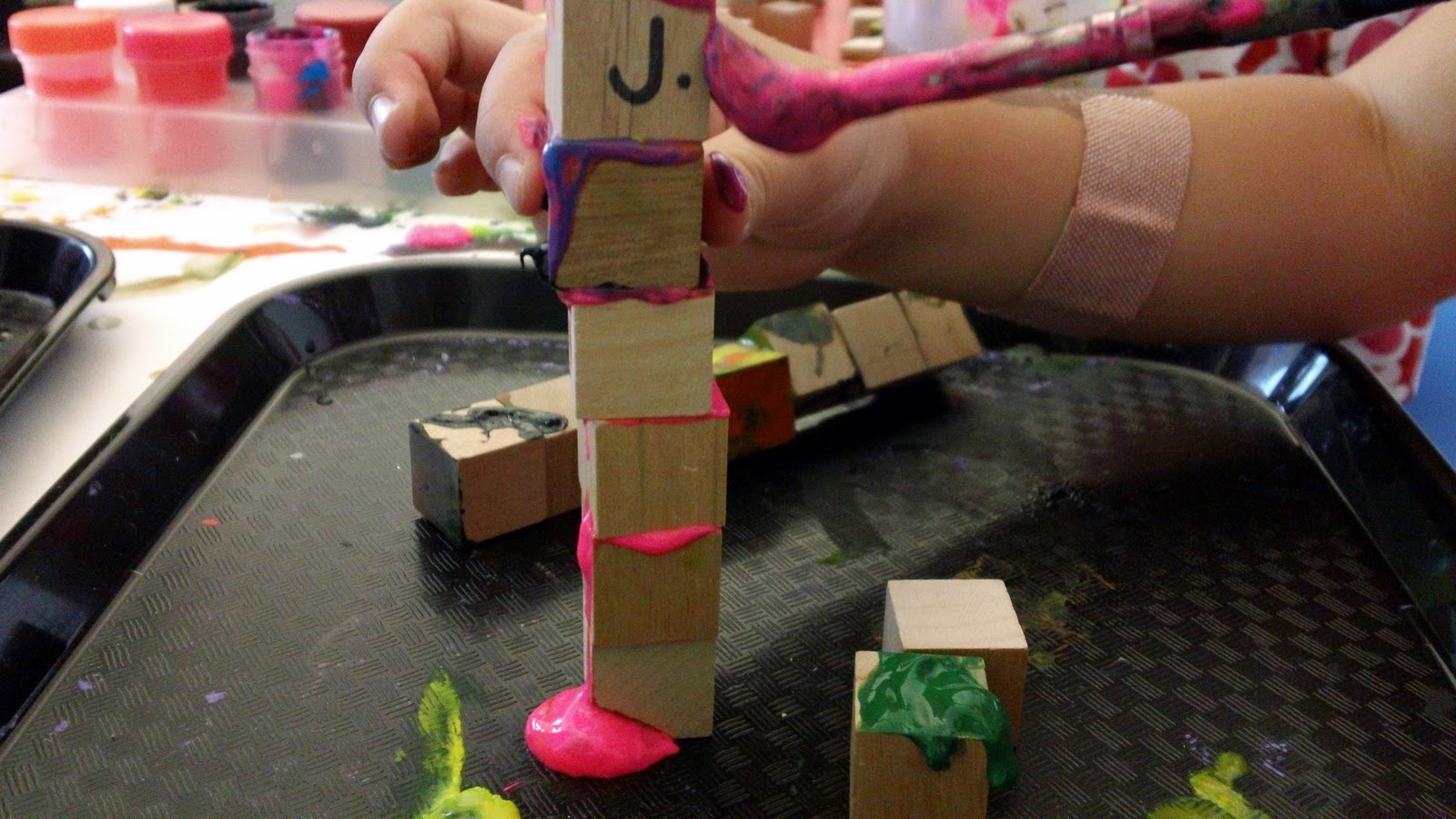
We painted small wooden cubes.  I found a box full of cubes that all had "J." written on them, and I had not prompted children with a 3D painting experience yet this school year.  This became a real example in expectation and vision versus the children's agenda.

My expectation was that the children would paint the blocks different colors, getting paint on their fingers as they turned them around and over and tried to get all sides.  Then, they would dry, and we would use them for some tabletop construction, or combine them with another material as a prompt. 

But from the very first child that sat down, the agenda was different.  Children began using the paint as a sort of glue, creating towers and other connected structures.

One of the reasons that I was surprised was because we do not have blocks in this classroom.  It makes me a bit sad that we do not have blocks because it has to be my favorite open ended material.  And when we use small table top blocks, like these or others, the children have not been engaging with them.  I have not found the reason why, and it only aded to my confusion when the children began making structures out of these cubes with the paint.

Many of the sculptures fell apart as they dried, and they have become the painted blocks I was expecting, and we'll use them again.  I have to remember that I can plan for our hours and days and weeks, but there will always be an unknown.  Maybe this is because I strive to make all of the opportunities open-ended and there will never be 15 worksheets traced and colored in, looking the same.  For me, this is better.  No one was forced to stay at this table and work for 20 minutes - they did that on their own accord.  They made the material more engaging than I could have planned for!

27 October 2011

Ramble on

Sometimes, a teacher has a bad day.  It happens in any profession - things are a little off; a few things combine to make work harder for some reason.  If you're sitting at a cubicle, it might be a frozen computer or things on the wrong forms and the beginnings of a cold.  Whatever your job, bad days happen.

For me, today was a bad day.  I could even quote the title of this book as an example of what I mean.  It starts with no breakfast and an especially cold morning on the Oregon coast and escalates to paint everywhere and miscommunication with colleagues and a commitment that requires a 45 minute drive in the afternoon when still, nothing has been eaten yet.  I was really having a pity party today.  And when a teacher is having a pity party, it turns out things get even worse because selfishness is not a positive trait in a teaching and learning environment.  It makes things harder than you can imagine.  But most of you out there reading are teachers, so perhaps you can sympathize.

The point of the story, though, is what got me out of that funk.  First, I had to realize that I was throwing a pity party and being selfish, and the child who was dropping pumpkins on the ground to "see if they bounce" was not doing that to get on my nerves - it was nothing personal.  My attitude had created a touch of unproductiveness in the classroom, so I sat down and made some notes about the pumpkin experiment.  And when it broke, it went into the sensory table with our other pumpkins that we have been dissecting.  Problem solved.  I left school and stopped by home, where I cried about fairness and sadness and everything else I could think of that has been bothering me.  I got an excellent hug from my husband and he listened to my hysterical storytelling of my morning.  That helped.  Then I got in the car with an apple and a big bottle of water to drive to another school, where I was scheduled to do some schoolwork - an observation of a Kindergartener for a presentation on assessment that I'm working on this semester for grad school.  I listened to sad music and realized that was not helping, so I changed it and sang along to the radio.  I drove down the coast and saw big expansive views of the Pacific Ocean and literally let out deep, calming breaths.

Then I got to the school to find that there were no children inside; no teacher either.  I started to panic that my day was not on the up and up, like I thought.  But I saw some movement outside, so I went out to find the children collecting mushrooms in the forest outside their door.  They were putting them in paper bags, one "kind" of mushroom for each bag.  They were planning to bring them inside and classify them, sketch them, weigh them, and measure them.  I was given a bag and they asked me to join in.  So one hour after leaving work in a stressed tizzy, I was standing on a Pacific Northwest rainforest hillside collecting mushrooms, with the ocean roaring nearby and the care and affection of children right next to me.  I stayed with them until the end of their school day and said I would be back in two weeks - and one boy asked why I wasn't coming again everyday.

He didn't ask me that because he knows me as a teacher.  He did not ask me that because I am some fantastically phenomenal person, or a celebrity.  Maybe he just likes playing with pattern blocks, which we did while I was there.  But he was being kind and affectionate.  I thought that I was cured my the mushroom picking - but I think that statement really cured me.  Before visiting that school today, I had planned to spend the evening in bed by the time we hit morning snack.  But I am reenergized.  I'm humbled by children - right now it is that one little guy in particular - but it is the attitude that I need to start every day with.  Our job is about the care and nurturing of children, no matter what the situation. And with their attention and questions and eagerness, they are caring for us, too.

If you are still reading, thank you for letting me ramble.  And I would love to hear about your day, too.

19 October 2011

sketchbooks encore


We started using our sketchbooks on Monday.  The process of introducing them is something I always forget about - it takes scaffolding, explanations, answering questions, reminding children that they don't go home until they are full...


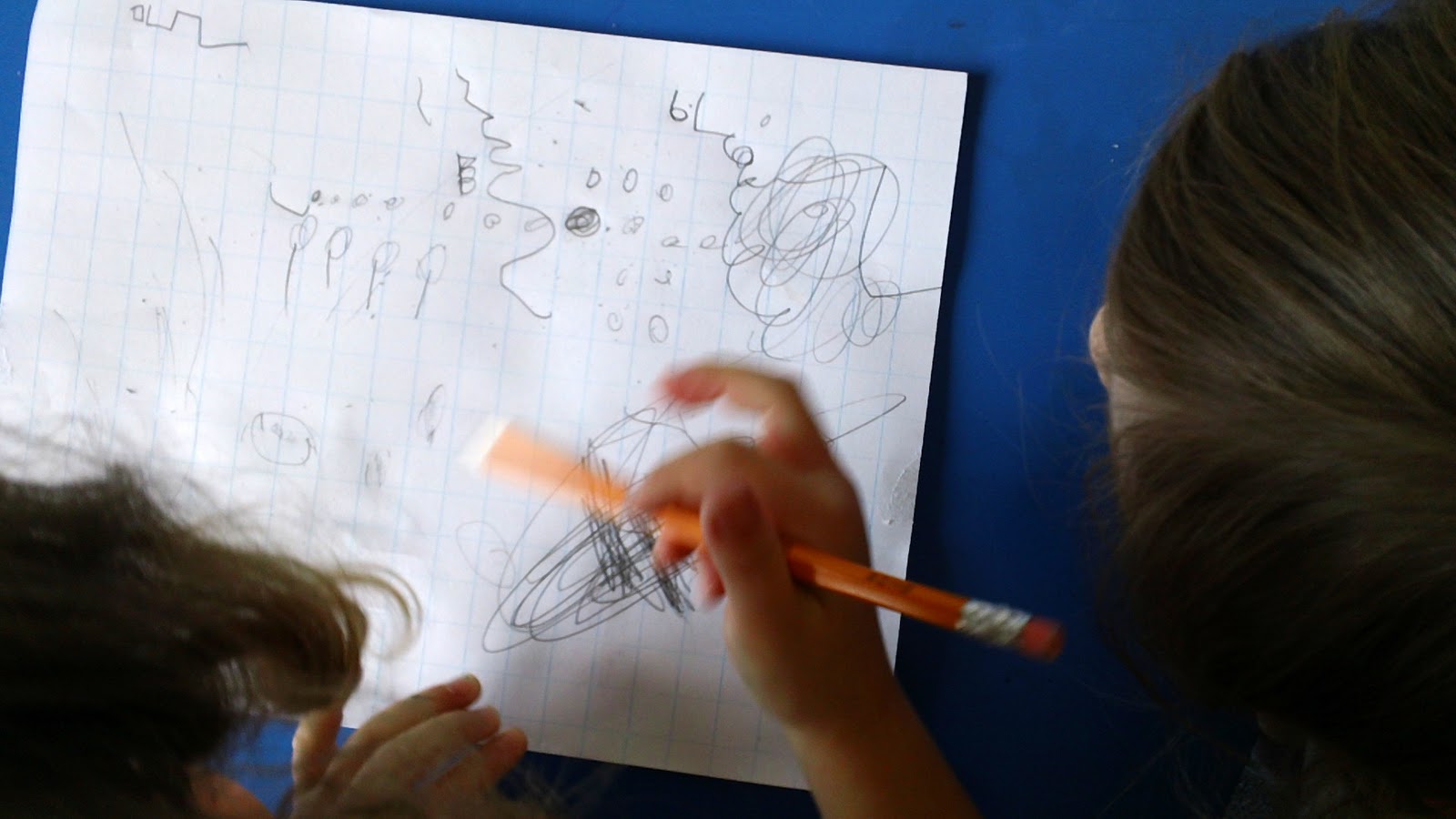
Although the children have been engaging with drawing and writing, it is not widespread.  The writing and drawing table is small and I don't think that the materials are presented in as engaging a way as they could be.  It is something to work on - but bringing sketchbooks into the mix is a way to promote drawing.  I think it is important for children to explore.  In my experience over the past few years, I think that children approach drawing in their sketchbooks as an experiment.  Each child's picture/scribble/letter/poked holes in the page will always differ from their neighbor's, and everyone quickly learns that its okay if it doesn't represent something, or if you can't label it.  We're just exploring.

On the first day, I showed the blank books at the start of the day and said that we would be using them right before lunch...every day.  When we cleaned up after work time, I put the books out and the children sat down and opened their books.  The prompt was to draw "anything".  Most children got right to it.  Some just looked at the book.  Some made a line and closed the book.  Some drew on every page.  We transitioned to wash our hands for lunch after sketchbooks, and some had to have numerous messages that we had to put them away soon.  This is a challenge I have had before.  If you type "sketchbooks" into the search bar on your right, you'll get some musings on how this has worked in the past.

On day two, the children were asked to "find the circle" in their sketchbook.  Some started drawing circles on the cover, one child ripped a page out of the book, others found the circle and started using it as a prompt for something"circle-like" (my expectation when planning the activity).  Most children used the prompt eventually.  Some just stared for the second day in a row.  

So, as we embark on our sketchbook journey once again, I'm giving myself a few tips.  First, these belong to the children and they should decide whether or not to follow the prompt.  In my experience, eventually, most will.  But they need time to explore what it means to have a sketchbook. I need to be patient.  Second, planning prompts on a regular basis is important.  We had lots of free draw last year, which was good, but some children, who would not normally choose to draw during work time, would make a mark, close the book, and move on.  Prompts helped.  Third, I need to observe and reflect on how this group uses sketchbooks to think about time.  How do we decide how long we work in them?  Does there even need to be a time limit?  This is something I've struggled with in the past.  Fourth, we need to make time to celebrate and share our sketchbooks as a group.  In pairs, in small groups, as a large group - the children's reflections on the experience can deepen the whole project.

Does anyone else use sketchbooks on a daily basis?  A weekly basis?

(I have used the UK project Sketchbooks in Schools for inspiration - I highly recommend it!)


18 October 2011

Pins and Paper

The writing I'm doing for Turtlewings does have me thinking about paper!  Old-fashioned clothespins and a long piece of lace were a prompt in the corner of the room last week.


I've been on a kick of planning prompts for this area of the room that change daily or every few days.  These prompts have been combinations of materials that I think the children might find interesting, and combinations that they may not have experienced together.  I'll make a point of taking photos of some of the prompts and sharing them here.

We are definitely interested in ripping and cutting paper, so we have amassed quite a pile of little paper bits.  And as interesting as gluing can be, the novelty wears off.  All of the children made attempts at pinning paper to the line; the ones who were independently successful stayed and added paper for longer periods of time.  I thought the lace would provide a more visual cue than string for this prompt, and the old fashioned clothes pins don't require any squeezing; they do require some thickness from the objects you're attempting to hold, though!

We may have more success with something like this against a wall, where the lace won't flip upside-down.  I think that the possibilities for pinning things to a line are endless!  As long as the materials are appealing and the children can do it with some independence, it can be engaging.

13 October 2011

Think About Dimension

I'm excited to be writing for the Turtlewings Think About Blog!  I'll be sharing thoughts on monthly topics from an early childhood educator's point of view.  Each topic will be looked at through different lenses, including art, education, and design.


This month, we're thinking about paper.  I hope you'll take a look!


11 October 2011

Colorful Circles


A two day creation; everyone helped.  Tracing, tracing attempts, tempera cakes, spilling water, ripping paper, laughing, more painting, more spilling water, much more ripping - it really is all about the process.  But the product is on the wall.


As a side note, I LOVE Tempera Cakes.  I cannot recommend them enough!  I bought one tray to try them out with the children, and it went really well.  In the future, I'd like to use ones that are just the cakes to mix and match in the tray so that children and teachers can pick and choose a few colors rather than have all of them.  But these were great.  


07 October 2011

Weekend Links

I'm really enjoying this blog, Make and Play, written by a mother and art educator in Russia Serbia (thanks vera!).  It is filled with children's work that is truly open-ended and carefully facilitated to make it meaningful and engaging.    The painting wall at their home and the banging wall in the woods are amazing!


Since I am clearly obsessed with TED talks, I'll share this one : The idea of "the balcony" is one that we need to embrace as early childhood educators.  It is so easy to act on our own feelings or assumptions about children's behaviors (and adult behaviors as well!), but stepping out and taking an outsider's perspective is worth the extra time.  I can see this being a real tool in problem solving with children.


I checked The Magic Hat by Mem Fox out of the library, and we have been reading it over and over again.  The teeny tiny stop sign is especially popular.

It is my niece's third birthday today, and I got her one of my favorite games for preschool : Snails Pace Race, made by Ravensburger.  It is a competition-less game: everyone takes a turn rolling the colored die and moving the snail corresponding to the color rolled; and the goal is to get all the snails across the finish line.  So no one "is" the pink snail, but you sure can predict it will win and cheer for it.  Someone even made a little video about it:


Happy Weekend!


06 October 2011

round and round and round...which one?


This is another moment from Wednesday that made me stop and look.  The children were tracing cups onto a big sheet of paper, but F used the cups in his own way.  He engaged the other children at the table with this game for 10 minutes.  At the start, he had two cups, and he kept track of the red lego and would not life the cup if the guesser guessed correctly.  When the third cup was added, children guessed until the lego was found and then they all celebrated...then put the lego under a cup and did it over and over again.

I can't plan this.  I can provide open-ended materials, and I can make suggestions, but I honestly believe that I cannot predict what will be most meaningful.  I can think about helping to expand ideas; I can document and help children revisit their work and support them with time, materials, and other resources they might need.  It is more work than choosing a theme for the children and planning activities on that theme, but the results are rewarding for everyone involved!

water + laughing


I have had moments when I have told children to stop something like this - pouring water on someone else.  These girls are clearly enjoying the pouring, the repetition, the sensory aspect of cool water on their arms - this is work.  An adult might stop them because they assume a child wouldn't want another to pour water on her arm; because it is to loud for the teacher's taste; because there is a "keep to yourself" type rule at the sensory table.

I love seeing things in the classroom that I have never seen before.  I'll share another moment that made me stop and think later today.

05 October 2011

So far, this week


Working and playing are one and the same.

"Making a successful project is like making a campfire. The child's interest is the spark. Your job is to run around a collect little twigs and sticks and offer them up. Also to say, "Can I get you anything?"

04 October 2011

interlocking planks + independence


These interlocking planks are in another part of the building that I work in.  I can't help but wonder if children saw a pile of them with no prompt except the planks (not made into a house) would they make them into a house?  How much adult support would children need with a material like this?  How much "coaching" to make the pieces fit together?

I miss the hollow blocks.

Related Posts Plugin for WordPress, Blogger...