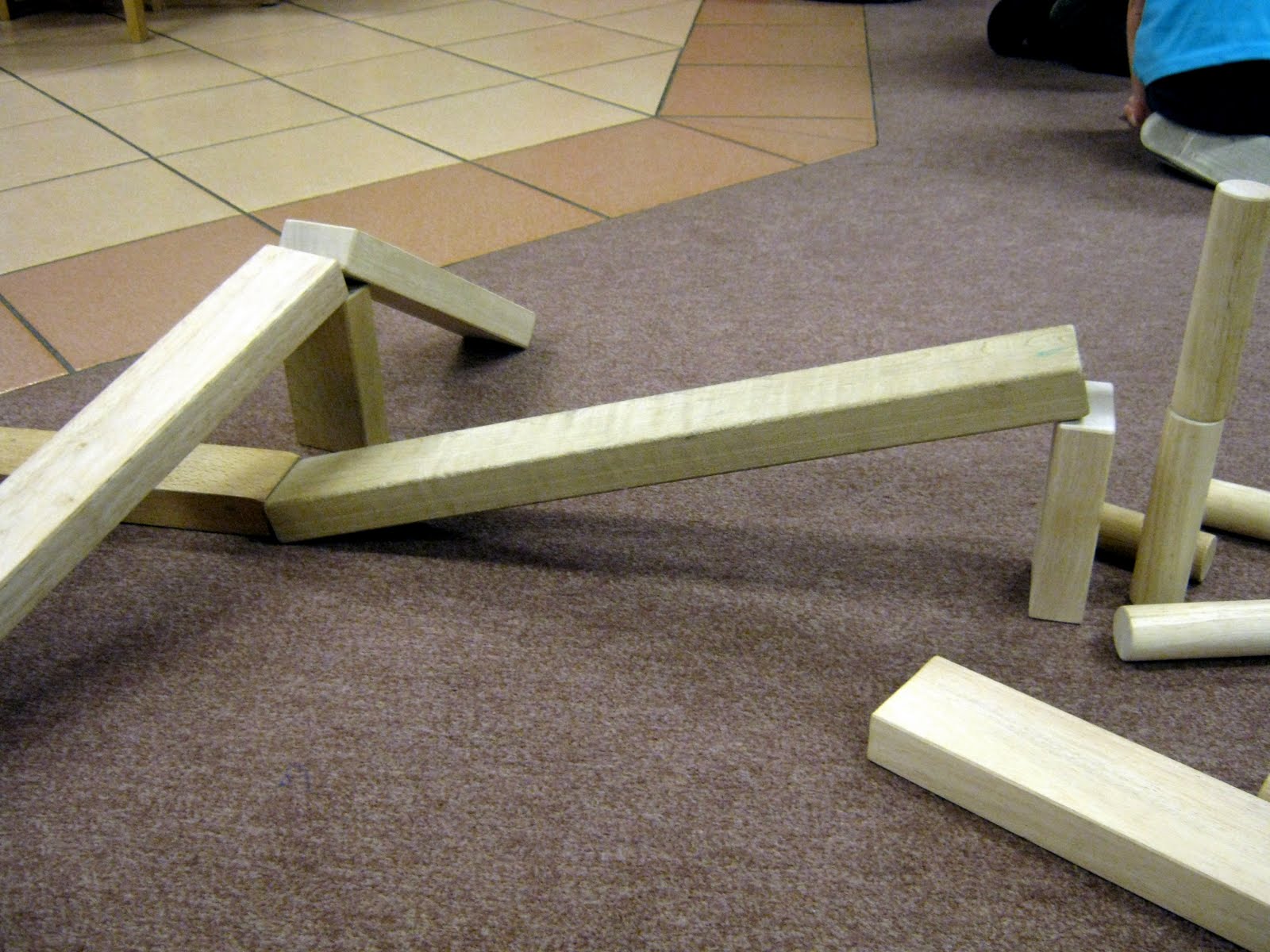
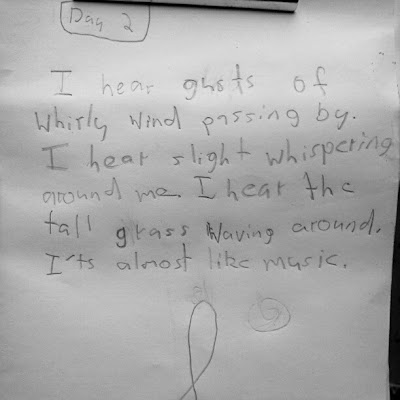
Some garden journaling from Farm Camp this week.
Showing posts with label writing. Show all posts
09 August 2012
27 September 2011
a wipe-off board and a typewriter
More tools to encourage the exploration of writing through play, along with some of the things children are making with them.
22 September 2011
a space for writing and play
Its almost silly how beautiful this room is. Look out the window, and you see Young's Bay, Saddle Mountain and the rest of the Oregon Coast Range, bridges, fishing boats, Coast Guard Helicopters - those are some exciting windows. I'd like to figure out how we can get the kids up to window level so that they can see a bit more. Stepstools? Crates? Giant blocks?
I don't think I've gone without a place for writing and drawing in the classroom in six years. Once I made it part of the environment, I never dismissed it. It can be an amazing gathering place - especially in a mixed age grouping like this one.
There is more to do to make this as inviting as it can be, but including a place for the to share the children's work is important. Hopefully this radiator cover will become that place for sharing. It is at the children's level, so they will be able to put things up and take them down. But for now, we're getting into the routine of using this as a writing and drawing space : the children go and get the materials they need (a variety of papers, writing tools, tape, glue, and the hot item of the moment, scissors) and they bring them to the table to write and draw and create - whatever they please. I sometimes forget that getting children into the routine of choosing for themselves and getting the items that they need takes a bit of time at the start. But we're definitely getting used to it. I'm really missing those black felt tip pens that we were up to our ears in at my last school! But the space comes together, little by little, and the more I watch and listen, the more I notice what we could add to promote writing. The right materials for will encourage writing through exploration.
For now, we're cutting up a storm!
21 June 2010
19 June 2010
01 December 2009
Writing
How can children communicate messages in writing?
What can writing look like at the age of four?
How do children understand the world of symbols and meaning, especially when they are exposed to multiple languages?
What can writing look like at the age of four?
How do children understand the world of symbols and meaning, especially when they are exposed to multiple languages?
07 October 2009
How does writing look right now?
Right now, we are getting comfortable enough to encourage mark-making and writing to send a message. As three-year-olds, the priority is making sure no one touches your things when you go off to do something else.
That is a big big part of our writing throughout the year - hourly, daily, and weekly. Signs, notes, postings.


That is a big big part of our writing throughout the year - hourly, daily, and weekly. Signs, notes, postings.
11 June 2009
I am in the midst of writing reports for parents. They are each a narrative "covering" four areas of their child's year: personal and social development; language and literacy; mathematical thinking; and learning through inquiry.
We did these once before, in December. I know my students, and I can write to each of these subjects. This is the first school I have worked at that has reports, and this is not how I would choose to share information with parents.
How do you share information with parents? Conferences? Reports? Portfolio sharing?
p.s. These last few weeks will be quite hectic, so I apologize for the inevitable lapses in writing. Perhaps you'll just see lots of photographs!
We did these once before, in December. I know my students, and I can write to each of these subjects. This is the first school I have worked at that has reports, and this is not how I would choose to share information with parents.
How do you share information with parents? Conferences? Reports? Portfolio sharing?
p.s. These last few weeks will be quite hectic, so I apologize for the inevitable lapses in writing. Perhaps you'll just see lots of photographs!
04 June 2009
because the cat ate all of the shoes in australia
We were inspired by Ruth Krauss today. We read a few pages from I'll Be You and You Be Me, and then set out to write a poem as a group of eight. The children liked the poem written "by a tree for some bugs". After some discussion, they chose to write a poem by a cat, for some shoes.
someone wearing a shoe
then a cat eat the shoe
maybe trying to get it off?
the cat would bite the shoelaces
the cat eat the shoe
the cat eat the shoelaces
and he eats it all up
a person comes out
and throws the cat outside
because the cat ate all of the shoes in Australia
a boy says, "the end!"
This is my first attempt at writing poetry with children. When we write a story together, I sometimes give them a first line to lead in. I didn't do that today -- instead I wrote everything the children said and that was the poem. We have been reading loads of poems of all kinds - rhyming and non-rhyming - and the children seem interested. Do you use poetry in the classroom?
More sharing about Ruth Krauss to come next week!
02 April 2009
Words of Interest
On Tuesday, we reflected on what has been happening lately in our classroom by drawing and writing in our journals. We provided some words to go along with popular interests...


12 March 2009
Parent Teacher Conferences
The best parent comment today, by far:
"Maybe we shouldn't be so strict with her at home. She is on her third [work]book of alphabets, and she has to trace the letters. But when we take the book out she cries."
(in response to my explanation of learning through experimentation and how we "teach" letters)
"Maybe we shouldn't be so strict with her at home. She is on her third [work]book of alphabets, and she has to trace the letters. But when we take the book out she cries."
(in response to my explanation of learning through experimentation and how we "teach" letters)
05 March 2009
Mermaid Man In The Bubble
Writing: Part Three
Inventive spelling is a stage of writing development that happens when children are allowed to explore and play with letters. When I began teaching, I will admit is was a little mysterious to me. I do not remember doing this as a child, and I certainly don't have any evidence that I did. But it is amazing to watch a child enter this stage because of how happy it makes them that people can read what they have written! It is a powerful thing to link letter sounds back to the letter and write it down.
In the examples that follow, the children were at the writing center in the classroom during choice time. My assistant and I have a policy of not spelling out words for the children whom we know are capable of spelling inventively. The examples come from the work of those children. Our assistance comes in the form of slowing down a word and helping them hear the individual sounds that a word contains, and celebrating them getting letters down onto the page.
For example, if a child is spelling "zoo", and I say "zzzz", they will hear a distinctive "z" sound; or perhaps they offer an "s". That's fine. Then I say "ooooo", and they say, "u", that is fine. I point at their word and slowly say "zzz-ooo, zoo!" I do not mind if it says "zu" ot "su" -- they can read it, and an adult who understands the concept of inventive spelling can as well.

Consonants are much easier to distinguish a sound from than vowels, and that is definitely reflected in inventive spelling. One of my students is constantly writing books with the same title: Princess, Princess, Princess. She includes all but one of the consonants here, and no vowels. This is a child who is very interested in princesses; and I imagine that her high exposure to the word "princess" in books and understanding of print has helped her remember the distinctive look of the "ss"at the end of the word.

In the examples that follow, the children were at the writing center in the classroom during choice time. My assistant and I have a policy of not spelling out words for the children whom we know are capable of spelling inventively. The examples come from the work of those children. Our assistance comes in the form of slowing down a word and helping them hear the individual sounds that a word contains, and celebrating them getting letters down onto the page.
For example, if a child is spelling "zoo", and I say "zzzz", they will hear a distinctive "z" sound; or perhaps they offer an "s". That's fine. Then I say "ooooo", and they say, "u", that is fine. I point at their word and slowly say "zzz-ooo, zoo!" I do not mind if it says "zu" ot "su" -- they can read it, and an adult who understands the concept of inventive spelling can as well.

Consonants are much easier to distinguish a sound from than vowels, and that is definitely reflected in inventive spelling. One of my students is constantly writing books with the same title: Princess, Princess, Princess. She includes all but one of the consonants here, and no vowels. This is a child who is very interested in princesses; and I imagine that her high exposure to the word "princess" in books and understanding of print has helped her remember the distinctive look of the "ss"at the end of the word.

"Fluffy"
This last example includes vowels -- children seem more likely to include ones at the end of words, especially when they have a distictive sound like "ee" or "oh".
I have seen parents and educators helping children spell by slowing down words to make different, distinct sounds, but then correct the children when they don't suggest the correct letter. How frustrating! If a child hears "k" at the beginning of "cookie"when they are five years old, is that a problem? In my opinion, no. Just today, the boy who wrote "The Kid Who Found Two Triangles In The Sky" wrote a book called "The Money Maker", and wrote "THE MNE MKR". He is beginning to memorize common, high usage words. As he learns more in higher grades, he will learn about sound blending and long and short vowels, but we have no need for that right now.
We just want children to feel that they are writers, no matter what they put on the page.
Next : Writing Stories and Books!
This last example includes vowels -- children seem more likely to include ones at the end of words, especially when they have a distictive sound like "ee" or "oh".
I have seen parents and educators helping children spell by slowing down words to make different, distinct sounds, but then correct the children when they don't suggest the correct letter. How frustrating! If a child hears "k" at the beginning of "cookie"when they are five years old, is that a problem? In my opinion, no. Just today, the boy who wrote "The Kid Who Found Two Triangles In The Sky" wrote a book called "The Money Maker", and wrote "THE MNE MKR". He is beginning to memorize common, high usage words. As he learns more in higher grades, he will learn about sound blending and long and short vowels, but we have no need for that right now.
We just want children to feel that they are writers, no matter what they put on the page.
Next : Writing Stories and Books!
03 March 2009
Writing: Part Two
After children draw and experiment with scribble writing, they begin to use letters in their writing.
The letters above were written by a four-year-old girl; some of the letters she wrote are in her name, and she is experimenting with their direction and placement.

This was written by a five year old; he, like the other children in these examples, is playing with random strings of letters. Children who are exposed to books and text gain the understanding that letters and words carry meaning, and they want to write as many letters as they see in books and in their environment, rather then just their name or a few letters.

This is another example of random strings of letters, and this one comes from a four-year-old. She worked on this for an extended period of time, about 15 minutes, in the writing center. In this piece, she is also writing short lines from left to right, and from top to bottom, showing her understanding of how text works.

I wanted to include an examples without letters to enter in my belief that there are multiple symbol systems that we can write. In the picture above, a four-year-old girl used the calendar in the classroom to copy all of the numbers. Writing numbers is as common as writing letters, especially when there are numbers in the environment to inspire the child. She also uses "mirror writing", which many children do for quite some time before writing the "correct" way. I have a few students this year who switch back and forth between the two depending on the situation, writing forwards one day and backwards the next.

Another symbol system that children in my classroom have been trying out a little is musical notation. The five-year-old above wrote this "song" -- when he finished he sang it for me:
One gray, Two pink
Three green, Four blue
Five orange...
...in ascending notes. I was quite taken by the five staff lines that he drew across the page. There are many more symbol systems that I am not mentioning here, but you get the idea!
Next will be my personal favorite: inventive spelling!
The letters above were written by a four-year-old girl; some of the letters she wrote are in her name, and she is experimenting with their direction and placement.
This was written by a five year old; he, like the other children in these examples, is playing with random strings of letters. Children who are exposed to books and text gain the understanding that letters and words carry meaning, and they want to write as many letters as they see in books and in their environment, rather then just their name or a few letters.

This is another example of random strings of letters, and this one comes from a four-year-old. She worked on this for an extended period of time, about 15 minutes, in the writing center. In this piece, she is also writing short lines from left to right, and from top to bottom, showing her understanding of how text works.

I wanted to include an examples without letters to enter in my belief that there are multiple symbol systems that we can write. In the picture above, a four-year-old girl used the calendar in the classroom to copy all of the numbers. Writing numbers is as common as writing letters, especially when there are numbers in the environment to inspire the child. She also uses "mirror writing", which many children do for quite some time before writing the "correct" way. I have a few students this year who switch back and forth between the two depending on the situation, writing forwards one day and backwards the next.
Another symbol system that children in my classroom have been trying out a little is musical notation. The five-year-old above wrote this "song" -- when he finished he sang it for me:
One gray, Two pink
Three green, Four blue
Five orange...
...in ascending notes. I was quite taken by the five staff lines that he drew across the page. There are many more symbol systems that I am not mentioning here, but you get the idea!
Next will be my personal favorite: inventive spelling!
02 March 2009
Writing: Part One
This week, I'll be sharing some thoughts about writing and young children. Reading and writing are essential skills, and their development begins in infancy and continues throughout a lifetime.
I'd like to say a few quick words about literacy development in the infant and toddler years. There is nothing more important to the healthy development of reading and writing skills than the development of oral language. Making noise and hearing language is the basis for everything else -- and i think people underestimate the importance of that fact. Children need time to play with language and sound and mouth movements and songs and rhymes and conversation before they write. I imagine most people who can ride a unicycle learned how to ride a bicycle first -- there are some basics that you should explore and experience in a logical order so that you do not get overwhelmed with the task at hand.
To learn about children's writing, you have to see children's writing. So today is for what writing looks like before letters.
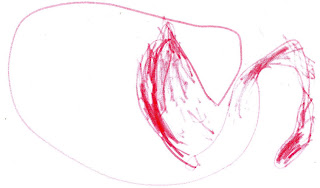
Above is a drawing made by a two-year-old. She is not making random scribbles -- her marks seem to have some intention. She has enough fine motor control to "color in" some of the lines. Her words for this were "Mommy, Daddy, Me."
This black pen drawing was made by a child who is three years old. There was more time spent on this piece, and he experiments with a variety of lines and shapes in his drawing. Learning about sharp lines and curves is learning about writing. Children are practicing the skills they are going to need to write letters. Experimentation is so important to writing development -- I know I do not have fond memories of tracing letters over and over and over again to learn how to write them properly. Open-ended art activities give children the opportunity to use their muscles to control the marks they make on paper with the tools that they choose, making them the expert rather than the manufacturer of a product.

These sticky notes are the writing that is done while some four-year-olds in my class are pretending to be on the phone. They are messages and phone numbers and addresses -- in scribbles from left to right, and from top to bottom. The children are pretending to write like adults do, an that imitation and practice is a great way for the children to develop those skills.

This last example is of a child using their environment to inspire their writing -- this is a four year old using writing in their environment (a sign-up sheet in the classroom) to inspire their own writing. This child is created a sign-up sheet, and then signed his own name on the top line.
These four examples are a pretty natural progression of writing development from two years to four years; but I am not one to etch things in stone. Many people refer to windows of development, and that is an excellent metaphor, especially for writing. Children may show no interest until five or six; they may skip scribbling; they may need extra help gripping a marker before this exploration can begin.
I find children's writing quite fascinating, and I'm looking forward to writing more about it! Tomorrow I'll be sharing some more writing samples from the next "stages" of writing development, and then talking about book writing and encouraging writing in the classroom.
I'd like to say a few quick words about literacy development in the infant and toddler years. There is nothing more important to the healthy development of reading and writing skills than the development of oral language. Making noise and hearing language is the basis for everything else -- and i think people underestimate the importance of that fact. Children need time to play with language and sound and mouth movements and songs and rhymes and conversation before they write. I imagine most people who can ride a unicycle learned how to ride a bicycle first -- there are some basics that you should explore and experience in a logical order so that you do not get overwhelmed with the task at hand.
To learn about children's writing, you have to see children's writing. So today is for what writing looks like before letters.

Above is a drawing made by a two-year-old. She is not making random scribbles -- her marks seem to have some intention. She has enough fine motor control to "color in" some of the lines. Her words for this were "Mommy, Daddy, Me."

This black pen drawing was made by a child who is three years old. There was more time spent on this piece, and he experiments with a variety of lines and shapes in his drawing. Learning about sharp lines and curves is learning about writing. Children are practicing the skills they are going to need to write letters. Experimentation is so important to writing development -- I know I do not have fond memories of tracing letters over and over and over again to learn how to write them properly. Open-ended art activities give children the opportunity to use their muscles to control the marks they make on paper with the tools that they choose, making them the expert rather than the manufacturer of a product.

These sticky notes are the writing that is done while some four-year-olds in my class are pretending to be on the phone. They are messages and phone numbers and addresses -- in scribbles from left to right, and from top to bottom. The children are pretending to write like adults do, an that imitation and practice is a great way for the children to develop those skills.

This last example is of a child using their environment to inspire their writing -- this is a four year old using writing in their environment (a sign-up sheet in the classroom) to inspire their own writing. This child is created a sign-up sheet, and then signed his own name on the top line.These four examples are a pretty natural progression of writing development from two years to four years; but I am not one to etch things in stone. Many people refer to windows of development, and that is an excellent metaphor, especially for writing. Children may show no interest until five or six; they may skip scribbling; they may need extra help gripping a marker before this exploration can begin.
I find children's writing quite fascinating, and I'm looking forward to writing more about it! Tomorrow I'll be sharing some more writing samples from the next "stages" of writing development, and then talking about book writing and encouraging writing in the classroom.
19 February 2009
18 February 2009
The Write Start
The other PreK teacher and I met today to organize some children's writing samples and write up some ideas about how to support children as emerging writers. I want to share more about that here, but I am home without my photos and scans. There is such an array of writing that is happening in any room of fours and fives, so I'll wait until I can show you what is happening!
But for now, I want to share someone else's thoughts and ideas on writing. Over at The Write Start, there is a four part tour of an at-home writer's workshop space. There are some really lovely ideas for supporting writing.
There are so many ways to scaffold young children as they learn to read and write, and those are just a few possibilities.
But for now, I want to share someone else's thoughts and ideas on writing. Over at The Write Start, there is a four part tour of an at-home writer's workshop space. There are some really lovely ideas for supporting writing.
There are so many ways to scaffold young children as they learn to read and write, and those are just a few possibilities.
Subscribe to:
Posts (Atom)